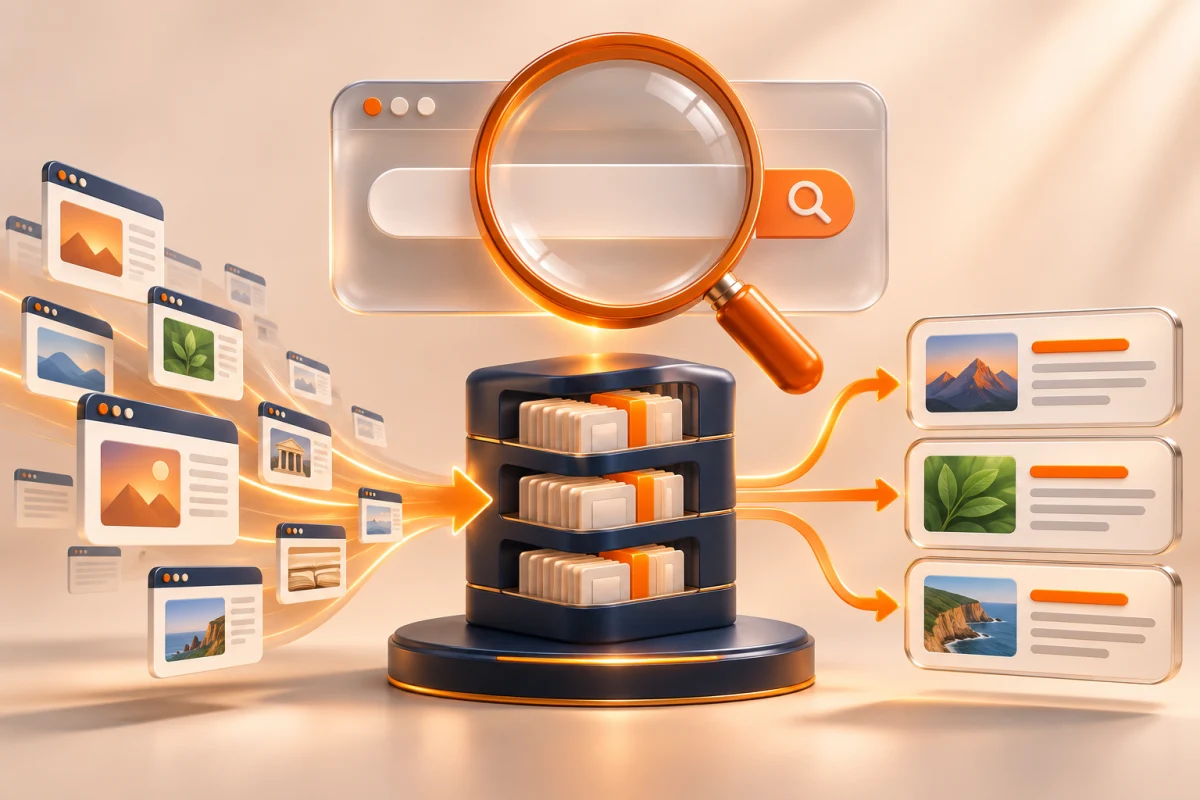
You type a few words into a box, press enter, and in less than a second you’re looking at a ranked list of answers pulled from billions of web pages. It feels like magic, but it’s a very large, very organised piece of engineering — and understanding it is the first step to being found by it. So, what is a search engine, which ones can you actually use, and how do they decide what to show you?
At Rank Matrix, a UK SEO agency, we explain this to business owners every week, because anyone who wants customers from search needs to know how search works. This guide covers it all in plain English: what search engines are, the main ones available in the UK (including the new AI ones), how they work behind the scenes, and what that means if you want your website to show up.
What is a search engine?
A search engine is a software system that finds information on the internet and ranks it in response to what you type or say. You enter a search query — “plumber in Leeds”, “how to remove a stain”, “best laptop under £500” — and the search engine returns a list of pages, images, videos, maps and other results it believes best answer you. That results page is called the search engine results page, or SERP.
Search engines don’t search the live internet when you press enter. That would be far too slow. Instead they continuously build a giant, organised copy of the web — an index — and search that. It’s a bit like the index at the back of a book: instead of reading every page to find a topic, you look it up and jump straight to the right place.
Search engine vs web browser: what’s the difference?
People often mix these up. A web browser (Chrome, Safari, Edge, Firefox) is the app you use to open websites. A search engine (Google, Bing, DuckDuckGo) is a website and service you use to find websites. Google is a search engine; Chrome is a browser made by the same company. You can use any search engine in any browser.
A short history of search engines
- 1990 — Archie. Widely regarded as the first search engine, it indexed file names on public FTP servers, long before the modern web.
- 1994–1995 — Yahoo and AltaVista. Early web directories and crawlers made the growing web easier to browse.
- 1998 — Google. Its PageRank idea treated links between pages as votes of trust, and results became dramatically more useful.
- 2009 — Bing. Microsoft relaunched its search offering under the Bing name.
- 2022 onwards — AI search. AI assistants such as ChatGPT began answering questions directly, and Google added AI Overviews to its results in 2024.
Which search engines are available?
There are dozens, but only a handful matter in the UK. According to StatCounter’s UK search engine market share data, Google handled roughly 91% of UK searches in September 2026, with Bing in second place at around 6%, then Yahoo, DuckDuckGo and Ecosia in the low single digits or below. These figures move month to month and vary by device, but the picture is stable: Google dominates, especially on mobile.
| Search engine | Best known for | Where its results come from |
|---|---|---|
| The largest index and the most UK searches | Its own index | |
| Bing | Microsoft’s search engine, built into Windows and Copilot | Its own index |
| Yahoo | A long-standing portal and search page | Largely powered by Bing |
| DuckDuckGo | Privacy: it doesn’t track your searches | Bing plus its own crawler and other sources |
| Ecosia | Uses its profits to plant trees | Bing results plus its own technology |
| Brave Search | Privacy and an independent index | Its own index |
| Mojeek | A UK-based independent search engine with no tracking | Its own crawler and index |
Google: the default for most people
Google is the engine most UK searchers mean when they say “search”. It crawls the web continuously and uses many ranking systems to judge relevance and quality. It also shows the richest results pages: the Local Map Pack, featured snippets, “People also ask” boxes, shopping results, videos and AI Overviews. For most businesses, ranking on Google is the main goal of SEO.
Bing and the engines that borrow from it
Bing is a full search engine in its own right and the engine behind Microsoft Copilot. It matters beyond its own share because other search engines, including Yahoo, and in part DuckDuckGo and Ecosia, use Bing results. Optimising for Bing therefore helps you appear in several places at once, and the fundamentals are the same as for Google.
Privacy-focused search engines
DuckDuckGo, Brave Search, Mojeek and Startpage appeal to people who don’t want their searches tracked. Startpage shows Google results through a privacy layer, while Mojeek and Brave Search run their own independent indexes. Their UK share is small, but they’re growing, and good SEO helps you appear on them too.
Regional search engines
Baidu dominates in China, Yandex is used in Russia and some neighbouring countries, and Naver is popular in South Korea. They rarely matter for UK businesses unless you sell into those markets.
AI search engines and answer engines
ChatGPT search, Perplexity, Microsoft Copilot and Google’s AI Overviews and AI Mode don’t just list links; they write an answer and often cite the sources they used. They work differently from classic search engines, but they still rely heavily on well-structured, trustworthy web content. We cover this in detail in how AI is changing SEO for UK businesses and in our guide to getting into Google’s AI Overviews.
Many people also search inside platforms: YouTube for videos, Amazon for products, TikTok and Instagram for ideas. These aren’t general search engines, but they are part of how customers find businesses.

How do search engines work?
Google’s own documentation, How Google Search works, describes three main stages, and other search engines follow a broadly similar model: crawling, indexing, and serving search results.
1. Crawling: discovering pages
Search engines use automated programs called crawlers (Google’s is called Googlebot) that follow links from page to page, downloading the text, images and video they find. There’s no central list of every web page, so crawlers constantly look for new and updated pages. Site owners can help by submitting an XML sitemap and by using a robots.txt file to tell crawlers which areas to avoid. If a crawler can’t reach a page, it can’t be indexed, which is why technical SEO is the foundation of everything else.
2. Indexing: understanding and storing pages
After crawling, the search engine analyses what each page is about: its text, headings, images, video, links and structured data. It also works out which version of a page is the main one when there are duplicates. Eligible pages are stored in the index, a database spanning hundreds of billions of pages. Importantly, indexing isn’t guaranteed: Google says not every page it processes will be indexed, particularly pages with thin, duplicated or low-quality content.
3. Ranking and serving results
When you search, the engine first works out what you actually mean, including spelling mistakes, synonyms and whether you want information, a product or a local business. Then its ranking systems pick the pages from the index that best match, in a fraction of a second. Google says its systems look at the meaning of your query, the relevance and quality of content, how usable pages are, and context such as your location and settings. The results page then shows whatever features suit the query: ordinary links, a map, images, videos, shopping results or an AI-generated summary. Google also states that it doesn’t accept payment to crawl a site more often or to rank it higher in organic results.
What decides which page ranks first?
No one outside the search engine knows every ranking signal, and they change constantly. But the main ingredients are well understood:
- Relevance: does the page match what the person is searching for, including their intent?
- Content quality and trust: original, accurate, helpful content from sources that show real experience and expertise, the principles behind Google’s E-E-A-T guidelines.
- Authority: links and mentions from other trusted websites act as endorsements.
- Page experience: fast, stable, mobile-friendly pages, measured partly by Core Web Vitals. Google predominantly uses the mobile version of a page for indexing.
- Context: your location, language, device and search history can all change the results you see, which is why “near me” searches differ from town to town.
Search engines also release regular updates to improve results. Our guide to how Google decides which websites rank first goes deeper on the signals, and our Google algorithm updates and core updates timeline explain how those changes can move rankings.
How do search engines make money?
Search engines are free to use because they earn money from advertising. Companies pay to appear in sponsored results at the top of the page, usually on a pay-per-click basis, and these are labelled as ads. Everything else is the organic results, which can’t be bought. Privacy-focused engines earn from ads too, but show ads based on the search itself rather than your personal history. If you’re deciding between the two routes to visibility, our comparison of SEO vs Google Ads explains when each makes sense.
Why search engines matter for UK businesses
When customers want something, they usually search first: “emergency plumber near me”, “best accountant for small businesses”, “how much does a new boiler cost”. The businesses that appear get the clicks, calls and enquiries. Because most UK searches happen on Google, and a large share are local, being visible there is one of the most valuable things a business can do. Local searches in particular are won in the Map Pack, which is why our local SEO checklist is one of our most-read guides.
What is SEO, and how do you get found in search engines?
Search engine optimisation (SEO) is the practice of improving your website so search engines can find, understand and trust it, and rank it for the searches your customers make. If you’re new to the idea, our plain-English guide, what is SEO, is the next step. In short, good SEO covers:
- A site search engines can crawl and index: clean structure, fast pages, no technical blockers.
- The right keywords: understanding what your customers search for, using keyword research and our guide to finding keywords UK customers actually search.
- Pages that match search intent: proper on-page SEO, supported by smart internal linking.
- Authority: trusted links through link building and digital PR.
- Local visibility: a strong Google Business Profile and local SEO if you serve a specific area.
- Readiness for AI search: content that AI assistants can understand and cite.
Results take time, and our honest guide to how long SEO takes to work explains what to expect.
Frequently asked questions
What is a search engine in simple words?
A search engine is a tool that helps you find things on the internet. You type in what you’re looking for, and it shows you a ranked list of web pages, images, videos and other results that best match. Google, Bing and DuckDuckGo are examples.
What is the most popular search engine in the UK?
Google, by a wide margin. StatCounter’s data put it at roughly 91% of UK searches in September 2026, with Bing second. The share is even higher on mobile phones.
Is Google a search engine or a web browser?
Google is a search engine. Google Chrome, made by the same company, is a web browser. A browser opens websites; a search engine helps you find them.
Which search engine is best for privacy?
DuckDuckGo, Brave Search, Mojeek and Startpage are designed not to track or profile your searches. No tool makes you completely anonymous, but these avoid building a personal search history the way ad-funded accounts can.
Are ChatGPT and Perplexity search engines?
They’re increasingly used like search engines, but they work differently: instead of ranking a list of links, they generate an answer, often citing web sources. Because they draw on web content, being well-optimised and trustworthy still helps your business get mentioned.
How long does it take for a new website to appear in search engines?
It can take anywhere from a few days to several weeks for a new site to be crawled and indexed, and there’s no guarantee that every page will be. Submitting an XML sitemap through Google Search Console helps. Ranking well for competitive searches takes much longer.
The bottom line
A search engine is simply a system that crawls the web, stores what it finds in an index, and ranks the best matches for each query. Google dominates in the UK, Bing and a handful of privacy-focused engines make up most of the rest, and AI answer engines are changing how people get information. The common thread is that all of them reward websites that are easy to crawl, genuinely useful and trusted.
That’s exactly what Rank Matrix SEO Agency UK helps you build. We provide complete search engine optimisation services: technical SEO, on-page SEO, off-page SEO and link building, local SEO, eCommerce SEO, national SEO, keyword research, content marketing, and AEO, GEO & AIO services for AI search, all under one senior-led team. You can see how we compare in our guide to the best SEO companies in the UK, check our SEO pricing, or explore our full range of SEO services.
Want to see how search engines currently see your website? Get a free SEO audit and a senior strategist will show you exactly what to fix first, or talk to our team about getting your business found.