Ever wondered why one website outranks another even when both seem to say the same thing? Often, the answer comes down to four letters: E-E-A-T. It’s one of the most talked-about ideas in SEO — and one of the most misunderstood. For UK businesses fighting for visibility on Google, understanding E-E-A-T isn’t academic; it’s the difference between being trusted enough to rank and being quietly left behind.
At Rank Matrix, a UK SEO agency, we build E-E-A-T into every campaign because Google rewards it more every year. This guide explains, in plain English, what E-E-A-T actually is, how it affects your UK rankings, and the practical steps to strengthen it on your own site — no jargon, no fluff.
What does E-E-A-T stand for?
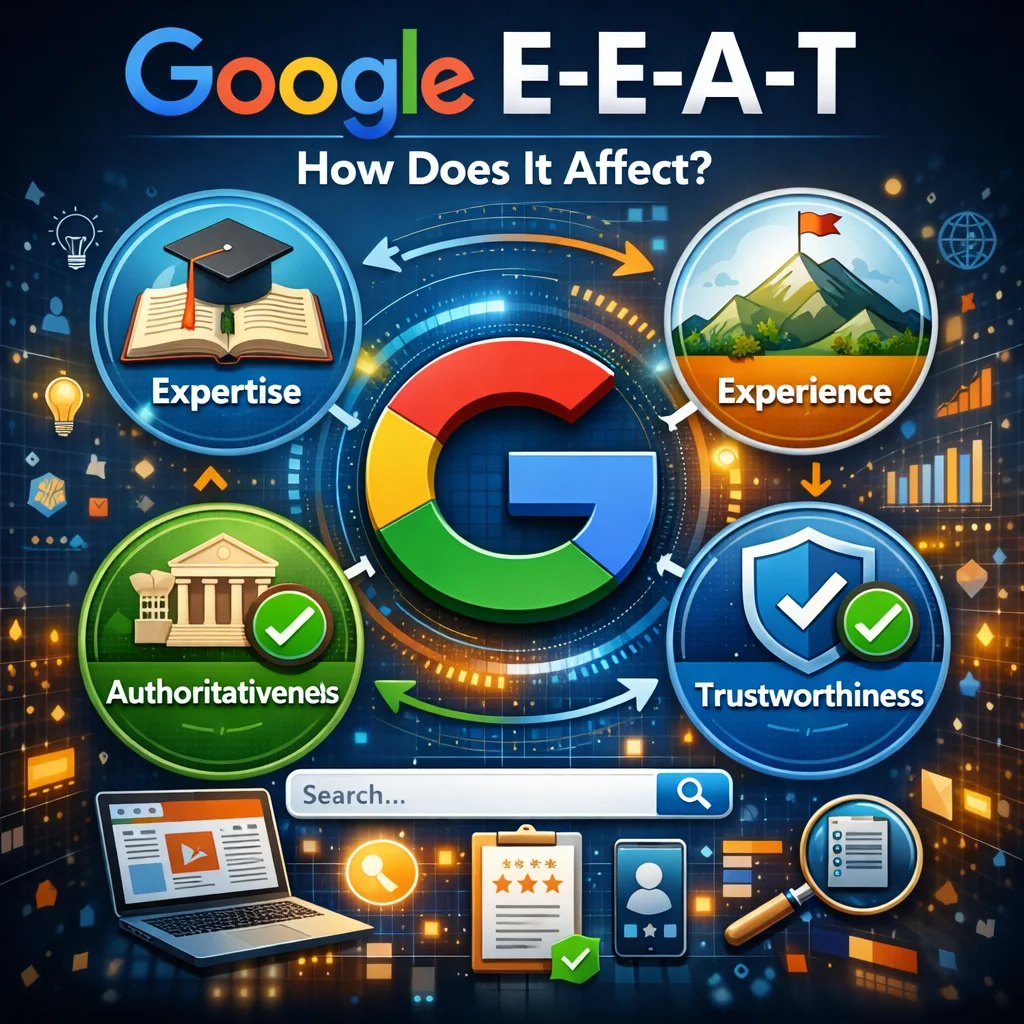
E-E-A-T stands for Experience, Expertise, Authoritativeness and Trustworthiness. It’s a framework Google uses (through its human Search Quality Raters and, indirectly, its algorithms) to judge how much a piece of content — and the site and people behind it — can be relied upon. The extra “E” for Experience was added to recognise first-hand, lived knowledge, not just textbook expertise. Together, the four pillars answer one question Google cares about deeply: can searchers trust this?
The four pillars in plain terms
- Experience: Has the author actually done or used the thing they’re writing about?
- Expertise: Does the author have the knowledge or qualifications to speak on it?
- Authoritativeness: Is the site (and author) recognised as a go-to source on the topic?
- Trustworthiness: Is the site accurate, honest, secure and transparent? This is the one that matters most.
Is E-E-A-T a ranking factor?
Here’s the nuance that trips people up. E-E-A-T is not a single score or a direct ranking factor you can dial up. Instead, it’s a concept that describes what Google’s many ranking systems are trying to reward. Google builds signals into its algorithms that approximate trust and authority, and its quality raters use E-E-A-T to assess whether those systems are working. So while you can’t “optimise the E-E-A-T number”, you absolutely can build the real-world signals that lead to better rankings — which ties directly into how Google decides which websites rank first.

Why E-E-A-T matters more for UK businesses in 2026
As AI floods the web with generic, mass-produced text, Google leans harder on trust to separate the credible from the noise. For UK businesses, that’s good news: genuine experience and local credibility are things a content mill simply can’t fake. E-E-A-T is also why staying on the right side of Google’s algorithm updates increasingly comes down to demonstrable trust rather than technical tricks. Build real authority and you become more resilient with every update, not less.
YMYL: where E-E-A-T matters most
E-E-A-T applies everywhere, but Google holds some topics to a far higher standard: “Your Money or Your Life” (YMYL) subjects. These are pages that could affect someone’s health, finances, safety or wellbeing — think medical advice, legal guidance, financial services or anything that could cause real harm if it’s wrong. If you’re a UK clinic, solicitor, accountant or financial adviser, weak E-E-A-T won’t just cost you a few positions; it can keep you off page one entirely. Strong trust signals aren’t optional in these sectors — they’re the entry fee.

How to improve E-E-A-T on your website
1. Show the real people behind your content
Add clear author bios with genuine credentials and experience, an honest “About” page, and real team details. Anonymous content struggles to earn trust. Let Google — and your readers — see the qualified humans behind the advice.
2. Demonstrate first-hand experience
Write from what you’ve actually done: real examples, results, case studies, photos and specifics only a practitioner would know. This is the “Experience” pillar in action, and it’s exactly what generic AI content can’t replicate — a key reason genuinely useful content marketing outperforms filler.
3. Build authority through quality links and mentions
Authoritativeness grows when other respected sites reference you — through earned coverage, citations and editorial links. A natural, quality backlink profile is one of the clearest external trust signals, which is why considered off-page SEO is central to E-E-A-T, not separate from it.
4. Make trust obvious and easy to verify
Trustworthiness is the foundation. Use HTTPS, publish clear contact details, display reviews and credentials, keep information accurate and up to date, and be transparent about who you are. For local businesses, an optimised Google Business Profile and consistent reviews reinforce trust — which is where strong local SEO earns its keep.
5. Keep content accurate, current and genuinely helpful
Outdated or thin pages quietly erode trust. Review and refresh important content, correct errors, and write to genuinely help the reader rather than to chase keywords. Matching real intent — found through proper keyword research — is part of being a trustworthy answer, not just a ranked one.
6. Get the technical foundations right
A slow, broken or insecure site undermines trust before anyone reads a word. Clean structure, fast loading, security and crawlability all support E-E-A-T from underneath — the job of solid technical SEO.
Common E-E-A-T mistakes UK businesses make
- Faceless content: no authors, no bios, no “who are we” — trust has nowhere to take hold.
- All claims, no proof: saying you’re “the best” without evidence, results or reviews to back it.
- Thin or AI-spun pages: generic content that adds nothing a reader couldn’t find elsewhere.
- Ignoring reputation: poor reviews, broken pages or out-of-date information left unaddressed.
- Treating E-E-A-T as a one-off: trust is built and maintained over time, not ticked off a list.
Frequently asked questions
Can I improve E-E-A-T quickly?
Some basics — author bios, HTTPS, accurate contact details, fixing thin pages — can be done fast. But real authority and trust build over months through consistent, credible work. There’s no overnight fix, and that’s precisely why it’s valuable.
Does E-E-A-T apply to small UK businesses?
Absolutely. A small, focused business that clearly shows real expertise and trust often out-ranks a larger, faceless competitor. E-E-A-T rewards credibility, not company size.
Is E-E-A-T more important than backlinks?
They’re not rivals — quality backlinks are one of the strongest signals of authority, which is part of E-E-A-T. Think of links as one important ingredient in the wider trust picture.
How do I know if poor E-E-A-T is hurting my rankings?
If you rank below thinner competitors, struggle in trust-sensitive (YMYL) topics, or lost ground after a core update, weak E-E-A-T is a likely culprit. A professional SEO audit will pinpoint exactly where your trust signals fall short.
The bottom line
E-E-A-T isn’t a setting you switch on — it’s the reputation your website earns by being genuinely experienced, expert, authoritative and trustworthy. For UK businesses, building it is the surest way to rank well today and stay resilient through whatever Google does next. Show the real people and proof behind your work, earn authority honestly, and make trust impossible to miss.
Strong E-E-A-T is also exactly what ChatGPT, Google AI Overviews and Perplexity look for before citing a source. If you want that trust translated into actual AI citations, our AEO, GEO & AIO services build on these same signals to get your brand recommended inside AI answers.
Not sure how your site measures up on trust and authority? Get a free SEO audit from Rank Matrix and we’ll show you exactly where your E-E-A-T is strong and where it’s costing you rankings. You can also explore our full range of SEO services or talk to our team about building lasting search authority.