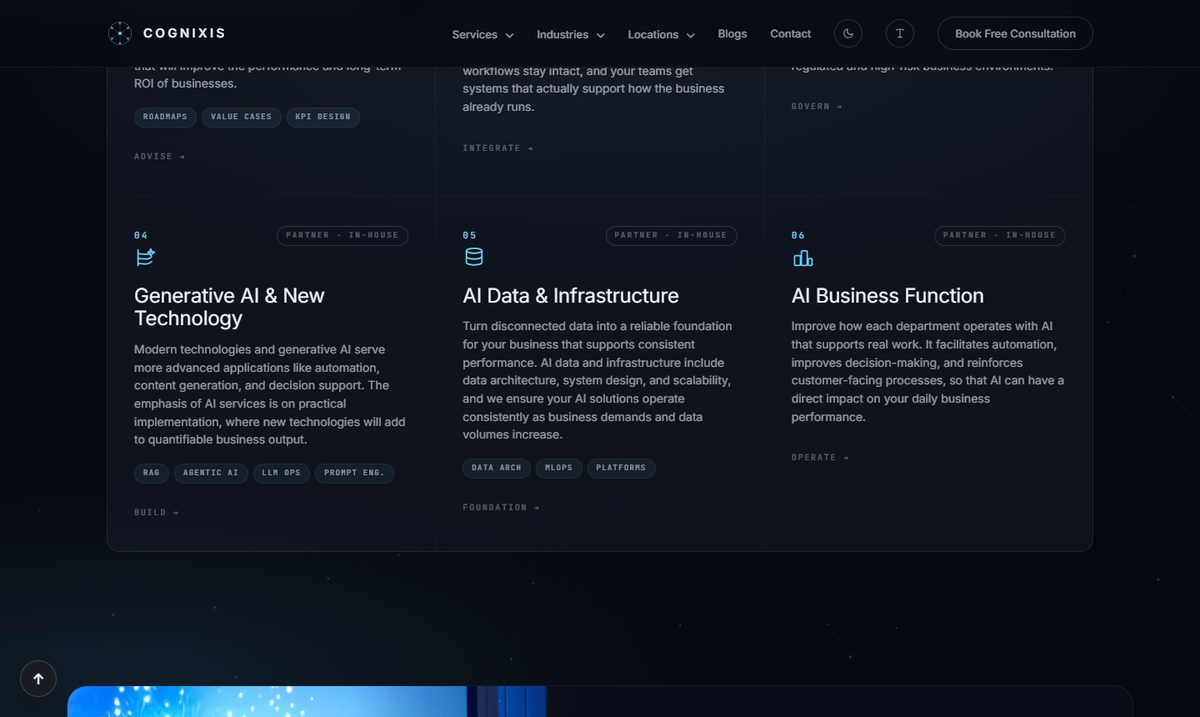
This AI consulting SEO case study describes how our SEO work supports the Cognixis website. Cognixis is a partner-led AI consulting agency, and AI consulting is a young, crowded and fast-moving market where buyers search in very specific terms. The project shows how a B2B brand can be found for those searches and turn interested visitors into enquiries.
If you are launching a consultancy or a technology service, the same approach applies. Our SEO for SaaS and software companies page covers how we adapt it for the UK market.
Project snapshot
| Client | Cognixis, a partner-led AI consulting agency |
| Website | cognixis.ai |
| Market | Businesses of all sizes looking for AI strategy, implementation and governance help |
| Our role | SEO services: SEO strategy, keyword research, on-page optimisation and ongoing SEO |
| Website platform | A custom-designed website with its own design system |
| Outcome | The website now generates enquiries and leads for the business |
The challenge: a brand in a noisy market
Almost every consultancy now claims to offer “AI strategy”. A brand has to stand out in two ways at once. It has to be easy for Google to understand, because buyers search for very specific services such as RAG consulting, AI governance or AI document processing. And it has to be clear to a busy executive within seconds why this firm is different.
The business also sells a considered, high-value service. Visitors need to trust the company before they get in touch, so the website has to educate as well as promote, and SEO has to bring the right visitors to the right page.
How the website is organised
A site architecture that mirrors how buyers search
The website has 69 URLs in its sitemap. The core of it is 40 dedicated service pages, covering strategy topics (AI strategy, readiness, governance, ROI and cost optimisation), implementation topics (generative AI, agentic AI, RAG, machine learning, LLM fine-tuning, computer vision and NLP), data and infrastructure, and business functions such as sales, marketing, customer service and document processing. Each page targets one specific search rather than trying to cover “AI consulting” in general.
Around that sit 16 industry pages, organised by company size (enterprise, mid-market, startups) and by sector (including financial services, healthcare, manufacturing, logistics, retail and technology), plus a locations section and a blog.
A problem-led message
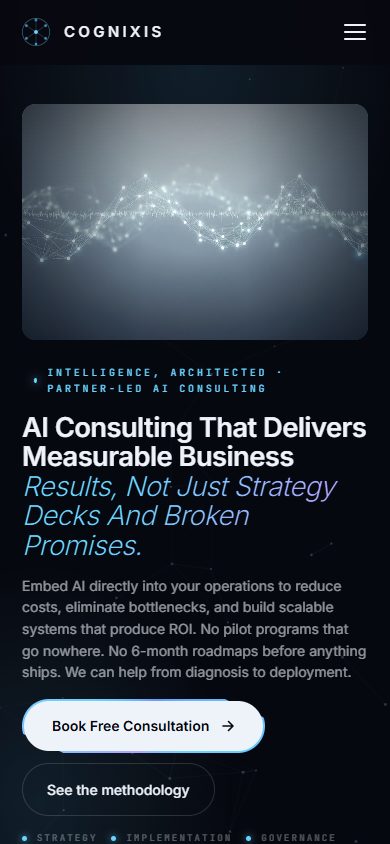
The home page opens with the buyer’s problem rather than a list of services: AI without a plan is an expense, not an investment. It then names the four reasons AI programmes stall (data architecture, governance gaps, scalability and business alignment), and moves to the firm’s approach from strategy to execution. A frequently-asked-questions section answers the objections an executive or committee typically raises.
A single, clear next step
Every page leads to one action: book a free discovery call. The enquiry forms ask for very little, a name and an email address on the home page, so the barrier to a first conversation is low.
The SEO strategy
- Topical coverage. A wide, well-organised set of service pages shows search engines that the site covers AI consulting in depth, and our SEO work builds on that. We explain the idea in our guide to what SEO is and how it works.
- Keyword research by service and intent. Each service and industry page needs a primary keyphrase written around how buyers phrase the search. See our keyword research services.
- Trust and expertise. The pages emphasise a partner-led, vendor-neutral approach and explain methodology, which supports the experience and expertise signals described in our guide to Google E-E-A-T.
- Content for researchers. A blog supports buyers who are still researching and are not yet ready to get in touch.
- Search that includes AI answers. Pages with clear headings and direct answers suit both traditional results and AI-generated answers. See our approach to AEO, GEO and AIO.
The result
The Cognixis website now generates enquiries and leads for the business. Our SEO work helps give a B2B brand a presence across dozens of specific searches rather than depending on one headline keyword. Every business, market and starting point is different, so this describes one project, not a promise of the same outcome elsewhere.
What this means for your business
- In a crowded market, specific beats generic. A page for each service you sell will reach buyers that one broad page cannot.
- Lead with the buyer’s problem, then show your method.
- Give a considered purchase one clear next step, such as a discovery call.
- Build trust with explanation: methodology, answers to objections and honest content.
Our complete SEO services help UK technology and consulting businesses do the same.
Frequently asked questions
How can a consultancy get found on Google?
Target the specific services you sell instead of one broad term, give each its own page, explain your approach clearly, and publish helpful content for buyers who are still researching. Trust signals such as methodology, expertise and honest answers matter as much as keywords.
Does a B2B company need industry pages?
If you serve distinct sectors, yes. Buyers often add their industry to a search, and an industry page lets you speak to their specific problems and compliance concerns while linking back to your core services.
How should an AI or technology website generate leads?
By making the next step obvious and low-risk, such as a free discovery call, and by earning trust first with clear explanations, case-based thinking and straight answers to common objections.
Want your website to generate enquiries for your consultancy?
Rank Matrix provides SEO services for B2B and technology businesses. Get a free SEO audit or talk to our team. More Rank Matrix case studies include a Canadian telecom company and a construction estimating service.